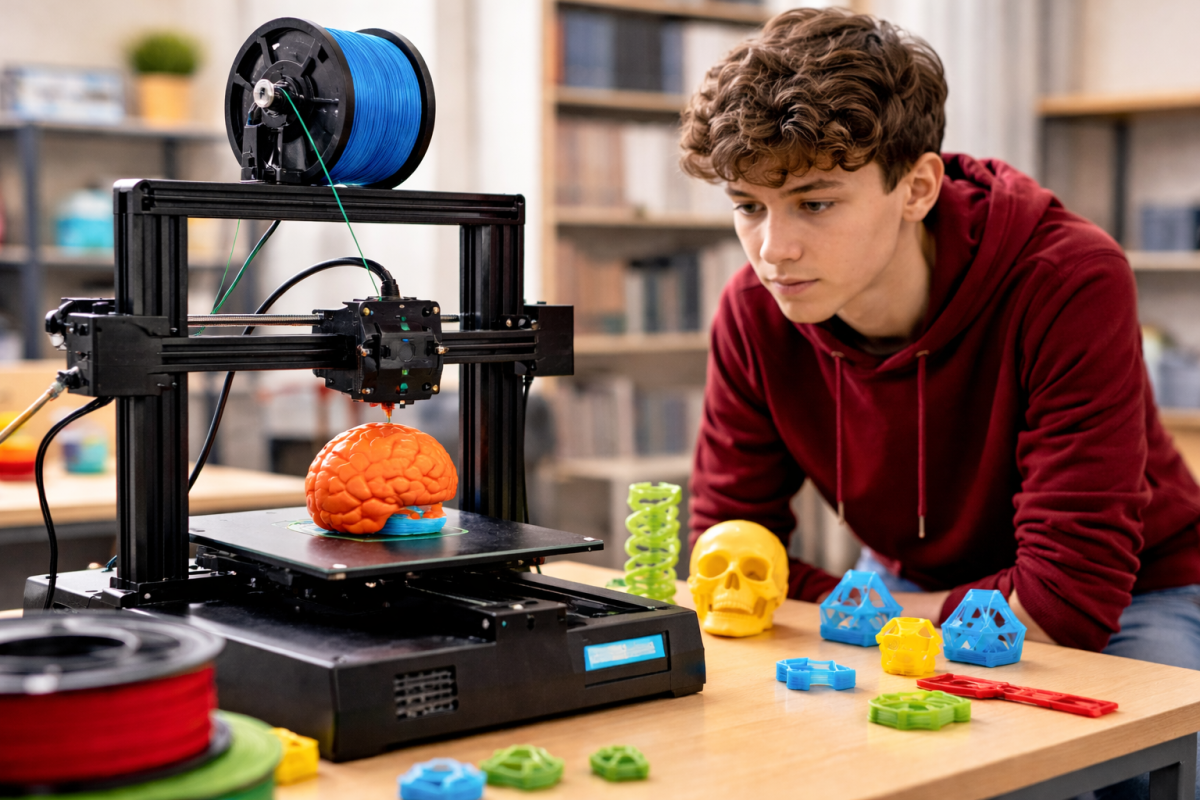












For decades, the idea of a 3D printer existed only in the realms of science fiction, until it became a reality in 1981. With a 3D printer, the right filament, and some knowledge of 3D modeling, you can create almost anything. While 3D printers are still considered a novelty by many people, they are becoming more popular and accessible. In fact, the Jacksonville Public Library has a 3D printer that can be rented for only a few dollars, and the library occasionally offers beginner classes that teach people how to use it.
3D printers have a wide variety of uses, ranging from rapid prototyping in business to making small toys at home to educational purposes. Ms. Hodges, who has been teaching for nine years and has experience working with 3D printers, shared some of the ways they could be used in schools. “It can be used to bring to life the things that students typically only see as diagrams,” Hodges said during an interview. “Especially with cells or anatomy, being able to print the actual anatomical structures of the body—like organs and bones—would be really cool for students to see and feel in their hands.”
 Hodges also pointed out that while the school has a few anatomical models, access is limited. “I know we have a few anatomical models sprinkled throughout the school, but imagine if we could have one for each group,” she said. According to Hodges, 3D printers are not just useful in science classes but across all subjects. In history classes, students could create replicas of artifacts or busts of historical figures. When asked about other applications, Hodges explained, “In math, you could use it for manipulatives,” which are physical objects that help students understand abstract concepts. “In ELA, it’s very similar. Having a model to go along with a story or a play, it could even be used for props. There are lots of opportunities to use it in the classroom.”
Hodges also emphasized the importance of student engagement. “Something that makes education really impactful is connecting it to the things that matter to students,” she said. “Being able to bridge the gap between hobbies and how they apply to what students are learning—I think the 3D printer is an opportunity for students to imagine things they care about within their education.”
There are already 3D printers at this school—three of them, located in the media center. However, they are rarely used. When asked why the school does not take full advantage of this resource, Hodges explained that software access is one of the biggest obstacles. “We have specific things that we are allowed to download,” she said, “and you can’t just go online and download whatever software you want. It has to be available through our district portal.” She added that the process involves contacting district software administrators and then creating training for teachers. “If you’ve never used something like this before, it can be intimidating,” she said.
Another major issue is cost. In order to use a 3D printer, filament is required. Filament is a thick, thread-like material—usually plastic—and it is to a 3D printer what ink is to a regular printer. Without it, the machine cannot function. A spool of filament can cost anywhere from $15 to $40, and different projects often require different types of filament, which can quickly become expensive. While machines like Filabot can turn plastic waste into filament, they often cost more than the 3D printers themselves. Additionally, some 3D model files must be purchased, although there are free resources available online, such as Cults3D and Thingiverse.